Monday, October 11, 2010

Getting to Know my Backyard

I've lived in my house for nearly a decade, but there are still parts of my yard that I have never completely embraced. Specifically, that pear tree in the back. When we first moved in, my next-door neighbor remarked on how good our pears were. I don't eat pears so I bagged some up for him in years that I remembered to pick them and didn't give the tree much more thought.


As I've matured (aged?), I've realized that pears are probably not the worst thing in the world. When they started arriving on my doorstep in my CSA delivery box, I had to do something with them so they went into my smoothies. Turns out I'm okay with the taste, just not the texture of whole pears. (My kids take after me and won't go near the pears...)

Now, that I eat this fruit, isn't it great that I have a pear tree? NO!!! For the past two years, I've waited for them to ripen on the tree and it just doesn't happen. Instead, my dear little pug waits for them to fall off the tree and then he brings them back INSIDE through the doggie door and eats them on the CARPET. Finally, I got fed up with this and decided to do some real research on exactly what kind of pears I have and why they never ripen. I learned that I have Bosc pears and they will never ripen on the tree. Who knew? So... I picked the ones I could reach, brought them inside and ripened them (as directed by the OSU Extension Service Garden Hints) in a bag with a banana. This takes advantage of the ethylene gas released by the banana. The other option is cold-storage ripening, but that seems to take much longer.

I did have perfectly ripe pears -- for about a day. They were quickly moving into overripe, so I blended them up and froze them. At least now I know I need to pick them when they are easy to pull off the tree, not when they feel ripe. Hopefully next year, I can save my carpet (and the pug) from the agony of too many pears!

It's taken years, but I'm glad I've finally acquainted myself with my pear tree and actually know what to do with it next year. Is there anything edible lurking in your yard that you have been happily ignoring? Next on my list is that wild mint - I don't even know if it's edible...

Enhanced by Zemanta

Thursday, September 30, 2010

Lessons from the Garden

OK, one gardening season under my belt and I learned so much!!


  • Planting early really does make a difference. I think about this a lot as I look at my tiny little eggplants and just hope for a few more of these 70+ degree fall days. Next year, I'll be ready!

  • Some years, there just isn't enough sun. I harvested TWO red tomatoes. Too bad I'm not hosting a Fried Green Tomatoes movie as I had hundreds of them! I take heart in the fact that I'm not alone after reading a recent local newspaper article dedicated to all us sun-deprived Seattle gardeners.

  • When the seed package says, "Plant 3 feet apart," they really mean it. I planted 3 tomato plants and it looked like a jungle.

  • Good soil makes a huge difference!


      • Stake plants before they get unruly. It is not possible to get a bigger tomato cage over the top of a tomato plant that has outgrown its too-small cage!


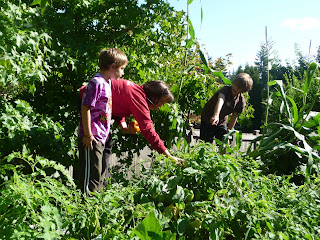
    • Gardens are a natural draw for kids. There's nothing better than hearing my boys show off their garden to friends that come to the house.
    • Home grown really does taste better, but... it does not necessarily make picky eaters into overnight vegetable lovers. Sometimes I just have to be happy that they will help grow, harvest, and wash the vegetable!

    Enhanced by Zemanta

    Tuesday, September 28, 2010

    Dozens of Dirty Dishes...

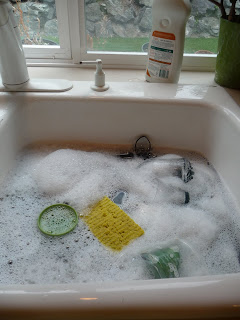
    Ugh... my dishwasher broke 17 days ago (not that I'm counting...) and I'm up to my neck in dirty dishes every day! Don't worry - I am not going to advocate that we all give up our dishwashers. I'm definitely willing to spend some energy on that appliance and, besides, with all the hot water and dish soap I'm using, I'm fairly certain hand-washing is not a better alternative.
    What I have learned (other than the fact that it takes a very long time to get a repairman to my house and even longer to order new parts) is that my family uses a lot of dishes! We had been happily humming along at just one dishwasher load each evening, but with the kids back in school (lots of small snack containers for school) and one extra person temporarily added to our family, we were suddenly needing to run the dishwasher more than once a day. Once I started hand-washing those dishes, I really started noticing.
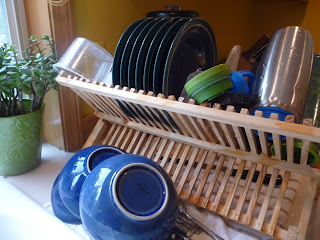
    Even if you do have a dishwasher - and, currently, I'm very jealous - who wants all those dishes? So, here are my tips for making less dishes, which makes for less full loads, and less work!

    * Consider the containers you send to school with kids. I haven't resorted to plastic baggies, but I am going to invest in some of those cool Bento boxes that let me pack multiple snacks in one dish. Anyone have a good recommendation?

    * Stop the flow of glasses - make the kids (and adults!) keep track of their drinking glasses so they don't use 5 separate glasses by the end of the day.

    * Use a single dish for mixing, serving, and storing. I've been guilty of making food in one dish, serving it in another, and then storing leftovers in a third dish.
    * Serve from the stove, rather than transferring dinner into another dish.

    * And, don't forget... kids can wash dishes too!

    Thursday, September 23, 2010

    National Prescription Drug Take-Back Day

    The DEA is sponsoring a National Prescription Drug Take-Back Day this Saturday, September 25th from 10 a.m. to 2 p.m. at thousands of sites across the United States. Why should you care?
    • Leftover prescription drugs in a medicine cabinet can be dangerous for young children (accidental ingestion) or older children (prescription drug abuse is America's fastest growing drug problem).
    • Disposing of the drugs by flushing them down the toilet or tossing them in the garbage can lead to pollution of either the water or the ground.
    Dietary supplement pills in four colors (orang...Image via WikipediaWhile many states have other drug take-back programs, this one is unique because it accepts narcotics. You might think you don't have any of these controlled substances in your house, but many people have half-full bottles leftover from past surgery, injuries, or dental appointments. I just checked my medicine cabinet and discovered a nearly full bottle of liquid Oxycodone (leftover from my son's elbow surgery) that I'll be dropping off on Saturday.
    Enhanced by Zemanta

    Tuesday, September 21, 2010

    Keeping our Beaches Clean

    Saturday, September 25th is International Coastal Cleanup Day. A great day to get out and enjoy the tail end of summer with your kids and keep the beaches clean. If you want to help out in your local area, check Ocean Conservancy's map to find the closest beach in your area.
    Of course, if there aren't any local events, you could always create your own or just head down to the nearest beach with a trash bag! A friend of my son's is already signed upFamous Beach at Surf Coast of VictoriaImage via Wikipedia and we're going to see if we can head down to Edmonds Beach to help out.
    Trash on the beach isn't a pretty sight, but it can be more than just ugly when it floats out to sea. All that trash can one day either ensnare or be consumed by a fish, bird, or other sea creature. And if that happens to be a fish or creature that we eat, we may be one day consuming that same trash that was once on our beach.
    Enhanced by Zemanta

    Monday, September 6, 2010

    Saving a Local Forest

    The kids are back in school and I'm hoping to morph back into a semi-regular blogger!

    For the past several months, I've been following a local story about the Whidbey Camano Land Trust and their efforts to save 664 acres of forest on Whidbey Island from development. The short story is that the land was sold for development and parceled into 124 plots. It subsequently went into foreclosure and the Whidbey Camano Land Trust secured the right to purchase it if they could raise $4.2 million.

    That number seemed far-fetched a few months ago - after all, Whidbey Island has a population of less than 60,000 and a good portion of those people are on a naval base on the other end of the island. Who would donate that kind of money? It turns out many different people and organizations have donated and I'm joining them. They still have to raise $500,000 by Friday, but I'm hopeful that my small donation puts them one step closer to their goal.

    I've never set foot on the property so why would I want to help save it? Maybe it's a romantic notion, but this is an island that I can see from son's room (how he ended up with the only view in the house, I'll never quite understand...). It's the island we look out on when we play at the beach.
    I like it because it's rural and I'd like to tell my kids that we helped keep it that way. It's also the island where my husband works twice a month so we feel a connection with the community. One day, I hope we can all visit this special forest!

    Friday, August 27, 2010

    Bubbles in the Water

    Bubble baths are great, but what about when you see bubbles in lakes, rivers, and oceans? I know my kids ask questions about how the bubbles get there. I'm not talking about the bubbles that seem to be generated by waves or the wake of the boat. I mean the ones that look like they just got poured out of your dishwasher.

    Here's a picture of Fish Lake - the big white spot is a wave, but those long lines are all bubbles. How did they get there?

    The big thing I've learned this summer is that the biggest impact of the water quality isn't the soap, detergent, and shampoo that goes down our household drains. This is good news because I remember once talking to a group of preschoolers about what they could do to help the Earth and one of them interpreted what I said as "Don't ever use soap." That's definitely not what I said, but I see how she could have interpreted it that way!

    The biggest impact to our waterways comes from things like the fertilizers and pesticides we use on our lawns, the oil that drips from our cars, and the soap bubbles from washing our cars in our driveway. Of course, we also have to think about the businesses that we're supporting that are also doing those same things - for example, the shiny red apples that get that way because of the sprays used to keep the bugs away. One day the chemicals from those sprays eventually wind up in our waterways.

    There are many other reasons to think about the products we use inside our house, but don't forget to look beyond the borders of your house to see how you might be contributing to all those bubbles.